Table of Contents
-
Why Is the Truck Mixer So Important in the Ready-Mix Concrete Industry?
-
History of the Truck Mixer – From Horse-Drawn Carts to Smart Trucks
-
Main Components of a Truck Mixer
-
Hydraulic System and Power Transmission
-
Concrete Discharge Chute
-
Water Tank and Washdown System
-
[Additional Content: Truck Mixer Types, Capacities, Applications, Standards, Maintenance & FAQs]
What Is a Concrete Truck Mixer?
If ready-mix concrete is the heart of the construction industry, the concrete truck mixer is undoubtedly its lifeblood. You might produce the highest quality concrete at the most sophisticated plant, but if it loses its properties during transport, all that precision and investment goes to waste. This is precisely why the truck mixer is one of the most critical pieces of equipment in the concrete industry.
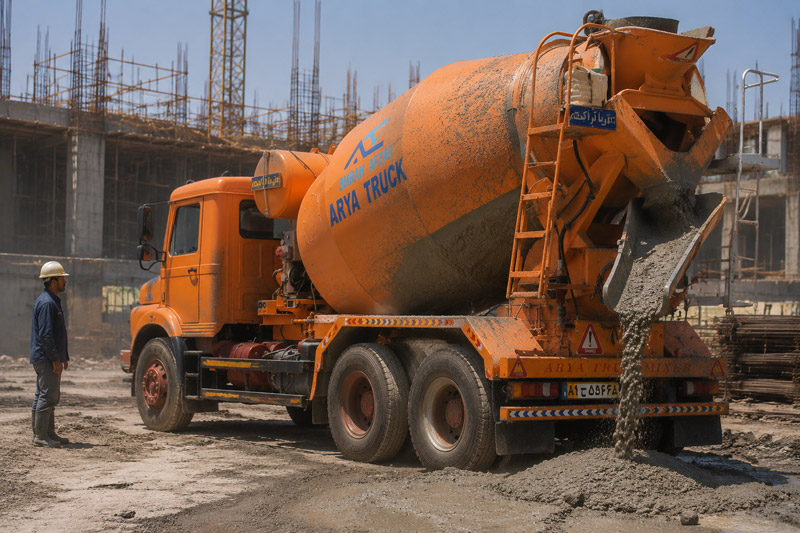
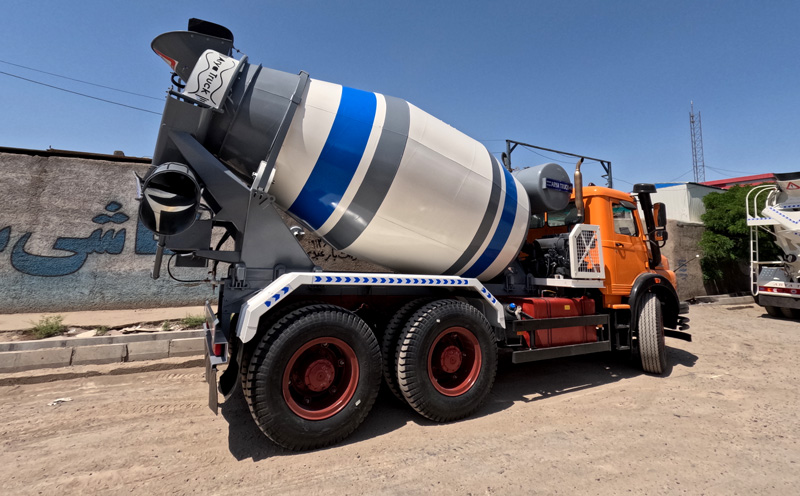
A concrete truck mixer (also known as a transit mixer or concrete mixer truck) is a heavy-duty vehicle with a rotating drum mounted on its chassis. Its primary function is to transport ready-mix concrete from the batching plant to the job site while preventing segregation, slump loss, or any reduction in quality.
Contrary to popular belief, a truck mixer is not merely a transport vehicle. In fact, it remains an active part of the concrete production process. Throughout the entire journey, the drum rotates at a controlled speed to ensure the concrete remains homogeneous, preventing aggregate settling or water separation from the mix.
Today, it is nearly impossible to imagine any medium or large-scale construction project without the use of truck mixers. High-rise buildings, bridges, dams, tunnels, factories, residential complexes, and road construction projects all rely on standard concrete transport fleets.
Why Is the Truck Mixer So Important in the Ready-Mix Concrete Industry?
Ready-mix concrete plants produce hundreds of cubic meters of concrete daily, but this concrete only holds value if it reaches the project site with its original quality intact.
If concrete remains stationary during transport, multiple problems arise in a short period:
-
Coarse aggregates settle at the bottom of the drum.
-
Water separates from the mix.
-
Workability is lost.
-
Slump decreases.
-
Concrete begins to set prematurely.
These issues can compromise the final strength of the structure and may even lead to concrete rejection by the project supervisor.
This is where the truck mixer's role becomes clear. Continuous drum rotation ensures the concrete remains in standard condition throughout the journey, arriving at the site without quality loss.
That's why many engineers believe that concrete quality depends not only on the plant but also significantly on the proper functioning of the truck mixer.
History of the Truck Mixer – From Horse-Drawn Carts to Smart Trucks
You might assume that truck mixers emerged alongside ready-mix concrete production, but the roots of this technology stretch back over a century.
In 1904, an inventor named Richard Bodlander patented the first concrete transport device equipped with a rotating container. It wasn't yet a truck – it was horse-drawn – but the core concept was the same one we see in today's truck mixers: maintaining concrete uniformity during transport.
A few years later, in the United States, T.L. Smith introduced the first mechanized concrete mixers, followed by Stephen Stepanian's idea of using trucks for concrete transport – an idea that later led to the development of modern truck mixers.
The rapid urbanization following World War II dramatically increased demand for ready-mix concrete. Since then, truck mixers have evolved in parallel with construction industry advancements.
Today, many advanced truck mixers are equipped with:
-
Electronic drum speed control
-
Hydraulic system performance monitoring
-
Drum rotation sensors
-
Digital display panels
-
GPS and fleet management systems
-
Concrete loading and discharge time logging
-
Fuel consumption monitoring
-
Service and maintenance alerts
These features have made ready-mix concrete transport far more precise than ever before.
How Does a Concrete Truck Mixer Work?
Many people assume the drum rotates simply to keep the concrete from hardening, but the reality is more complex.
After loading at the plant, the drum begins rotating at a specific speed. Inside the drum, spiral blades (or mixing fins) move the concrete as the drum turns.
This rotation serves three essential purposes:
-
Maintaining concrete uniformity
-
Preventing material segregation
-
Preserving workability until discharge
When the truck reaches the job site, the drum rotation direction is reversed. The same spiral blades that kept the concrete moving inward during transport now guide it toward the discharge chute.
This clever design means both mixing and discharging can be accomplished simply by reversing the drum direction – no additional equipment required.
Main Components of a Truck Mixer
While all truck mixers may look similar from the outside, this machine consists of a complex combination of mechanical, hydraulic, and structural systems, each playing a critical role in preserving concrete quality.
Let's explore the most important components.
The Drum – The Heart of the Truck Mixer
The drum (or mixing drum) is the most important part of any truck mixer.
This cylindrical vessel is typically constructed from abrasion-resistant steel such as ST52 or Hardox, enabling it to withstand years of wear from sand, gravel, and cement.
Inside the drum, spiral blades are positioned in a design refined by decades of engineering experience.
During rotation, these blades:
-
Mix the concrete thoroughly
-
Prevent aggregate settling
-
Preserve ready-mix concrete quality
-
Guide concrete toward the outlet during discharge
The build quality of this component directly affects both the truck mixer's service life and the quality of the concrete it carries.
Chassis and Carrier Truck
The mixing drum is mounted on a heavy-duty truck chassis responsible for carrying the load.
Given the enormous weight of concrete, the chassis must possess exceptional strength and durability.
Today, truck mixers are typically mounted on chassis from brands such as Mercedes-Benz, Volvo, Scania, MAN, FAW, HOWO, and other heavy-duty truck manufacturers.
Beyond supporting the concrete weight, the chassis must also withstand the forces generated by continuous drum rotation.
Hydraulic System – The Drum's Driving Force
Drum rotation is powered by a robust hydraulic system.
This system consists of:
-
Hydraulic pump
-
Hydraulic motor
-
Gearbox
-
Oil reservoir
-
Control valves
Proper operation of this system ensures the concrete is agitated at the standard speed throughout the entire journey.
Concrete Discharge Chute
Once the truck arrives at the project site, the concrete must be discharged precisely without segregation. This is the job of the discharge chute.
The chute consists of multiple metal sections with adjustable angles and extendable length, allowing precise concrete placement. In many projects, the chute directs concrete directly into a concrete pump, formwork, or foundation.
Modern chute designs focus on:
-
Faster discharge rates
-
Minimized concrete waste
-
Quicker washdown
-
Enhanced operator safety
Some advanced models even allow chute control from outside the vehicle or from within the cab.
Water Tank – Small Component, Big Role
Nearly all truck mixers are equipped with a water tank, but its purpose extends beyond just washing the drum.
The water tank is used for:
-
Drum washdown after discharge
-
Chute and equipment cleaning
-
Completing mixing in certain production methods
-
Preventing concrete from hardening inside the drum
Important note: Adding water to ready-mix concrete at the job site should only be done with the technical supervisor's approval. Unauthorized water addition alters the water-cement ratio and reduces the concrete's final strength.
Types of Concrete Truck Mixers
Truck mixers are categorized based on mixing method, discharge configuration, and capacity.
-
Central-Mix Truck Mixers
This is the most common type in Iran and many other countries.
In this method, concrete is fully mixed at the plant, quality-checked, and then loaded into the truck mixer.
The drum rotates at a low speed only to:
-
Keep the concrete uniform
-
Prevent aggregate segregation
-
Maintain slump
-
Preserve original quality
Nearly all standard ready-mix plants use this method.
Advantages:
-
Uniform quality
-
Precise lab-controlled mix design
-
Higher concrete strength
-
Fast production rates
-
Dry-Batch Truck Mixers
In this method, dry materials – cement, sand, and aggregates – are loaded into the drum along with water. Complete mixing occurs during transit.
This system is more common in North America and less frequently used in Iran.
Advantages:
-
Ability to transport materials over long distances
-
Greater production flexibility
Disadvantages:
-
More difficult quality control
-
Greater reliance on operator performance
Truck Mixer Types by Discharge Location
Rear-Discharge Truck Mixers
This is the most common type in Iran.
The discharge chute is located at the rear of the vehicle, and the driver typically performs the discharge operation with assistance from an operator.
Advantages:
-
More affordable
-
Easier maintenance
-
Widely available parts
-
Broad application range
Front-Discharge Truck Mixers
In this model, the chute is located at the front of the truck, allowing the driver to control the entire discharge operation from inside the cab.
This type is more commonly used in large-scale projects and developed countries.
Advantages:
-
Greater precision
-
Reduced labor requirements
-
Better driver visibility during placement
-
Enhanced safety
Truck Mixer Capacities
Drum capacity is one of the most important selection criteria for a truck mixer.
The right capacity choice depends on project type, distance from the plant to the site, route conditions, and concrete volume requirements.
6 m³ Truck Mixer
Suitable for:
-
Residential projects
-
Narrow streets
-
High-traffic urban areas
7 m³ Truck Mixer
One of the most common capacities for medium-sized projects.
Features:
-
Good maneuverability
-
Economical fuel consumption
-
Optimal discharge speed
8 m³ Truck Mixer
Offers an excellent balance between transport capacity and vehicle dimensions.
Applications:
-
Multi-story buildings
-
Commercial complexes
-
Urban projects
9 m³ Truck Mixer
Widely used in many ready-mix plants today.
Advantages:
-
Fewer trips required
-
Increased productivity
-
Lower transport cost per cubic meter
12 m³ Truck Mixer
Suitable for:
-
Industrial projects
-
Dam construction
-
Bridge construction
-
Large-scale civil works
This model requires more powerful chassis and stronger hydraulic systems.
14 m³ Truck Mixer
The largest common capacity for specific projects.
Applications:
-
Large ready-mix plants
-
National infrastructure projects
-
Mass concrete pours
Using this model reduces the number of transport trips and accelerates project timelines.
The Truck Mixer's Role in Maintaining Ready-Mix Concrete Quality
Many believe concrete quality depends solely on the producing plant, but in reality, the moment concrete leaves the plant, it enters a new critical phase.
If concrete is transported without agitation, within a short time:
-
Sand and aggregates settle out
-
Water rises to the surface
-
Uniformity is lost
-
Slump decreases
-
Final concrete strength drops
Continuous drum rotation prevents all of these problems.
That's why international ready-mix concrete transport standards mandate truck mixers for most projects.
Important Standards in Truck Mixer Design and Manufacturing
A truck mixer is not just a truck with a rotating drum. It must be designed and manufactured according to international standards to maintain concrete quality for years under harsh working conditions.
A standard truck mixer should possess the following characteristics:
-
Drum constructed from abrasion-resistant steel
-
Engineering-designed internal blades
-
Chassis matched to load capacity
-
Powerful and stable hydraulic system
-
Proper weight distribution across axles
-
Quick washdown system
-
Easy access for maintenance
-
Optimal fuel consumption
-
Good balance during travel
The higher the build quality of these components, the longer the truck mixer's service life.
Why Is Drum Material So Important?
The most significant wear and tear on a truck mixer occurs inside the drum.
Sand, gravel, and aggregates act like sandpaper during rotation, gradually wearing down the internal walls and blades.
If ordinary steel is used in drum construction, within a relatively short period:
-
Wall thickness decreases
-
Blades wear down
-
Mixing capacity declines
-
Transport quality deteriorates
That's why reputable manufacturers typically use abrasion-resistant steels like ST52 or specialized wear-resistant alloys.
Key Considerations When Buying a Truck Mixer
Purchasing a truck mixer is a long-term investment, and drum capacity alone should not be the deciding factor.
Before purchasing, it's advisable to evaluate the following.
Drum Quality
Steel thickness, grade, and welding quality are critically important.
Hydraulic System Type
The pump, motor, and gearbox should come from reputable brands – failure in this area can bring the entire machine to a halt.
Internal Blade Quality
Proper blade design directly impacts mixing quality and discharge efficiency.
After-Sales Support
Without adequate parts and service support, a truck mixer can become a costly burden.
Project-Appropriate Capacity
Choose capacity based on the type of work.
-
Urban projects are generally better suited to 6 to 9 m³ capacities.
-
Large ready-mix plants benefit from the productivity of 12 and 14 m³ models.
Truck Mixer Maintenance
Like any industrial machine, a truck mixer's service life depends on how well it is maintained.
The most important maintenance practices include:
Daily Drum Washdown
If concrete remains inside the drum, it will harden over time and reduce the usable volume.
Hydraulic Oil Checks
Contaminated or low oil will damage the hydraulic motor.
Internal Blade Inspection
Blade wear reduces mixing quality.
Bearing and Roller Checks
These components bear enormous weight and should be inspected periodically.
Chute Connection Checks
Loose connections during discharge can create safety hazards.
Regular Greasing
Proper greasing extends the life of moving parts.
Common Mistakes in Truck Mixer Operation
In many projects, concrete problems stem from improper truck mixer operation.
The most common mistakes include:
-
Adding water to concrete without technical supervisor approval
-
Incomplete drum washdown
-
Transporting concrete beyond the allowable time limit
-
Overloading beyond rated capacity
-
Using incorrect drum rotation speed
-
Delays in concrete discharge
-
Neglecting scheduled maintenance
Paying attention to these simple points can significantly extend the truck mixer's lifespan and improve concrete quality.
New Technologies in Modern Truck Mixers
Today's truck mixers are no longer purely mechanical machines – many are equipped with smart technologies.
These include:
-
GPS systems
-
Real-time fleet tracking
-
Loading time logging
-
Discharge time recording
-
Digital display panels
-
Electronic drum speed control
-
Scheduled service alerts
-
Driver performance logging
-
Fuel consumption monitoring
These technologies help ready-mix plants monitor concrete transport quality in real time.
The Future of Truck Mixers
The concrete transport industry, like others, is evolving.
In the coming years, we can expect to see the expansion of:
-
Hybrid truck mixers
-
Fully electric models
-
AI-powered smart fleet management
-
Remote drum performance control
-
Automated washdown systems
-
Online concrete temperature sensing
-
Real-time slump measurement
These innovations will not only reduce costs but also further improve ready-mix concrete transport quality.
FAQ
What is a concrete truck mixer?
A concrete truck mixer is a truck equipped with a rotating drum, responsible for transporting and maintaining the quality of ready-mix concrete from the plant to the project site.
Does a truck mixer produce concrete?
For most projects in Iran, no. The concrete is first produced at the plant, and the truck mixer only transports it while maintaining uniformity.
What are the common truck mixer capacities?
Common capacities include 6, 7, 8, 9, 12, and 14 cubic meters.
What's the difference between a truck mixer and a regular concrete transport truck?
A truck mixer has a rotating drum that preserves concrete quality, while a standard concrete transport truck does not have this capability.
Why is a truck mixer essential for ready-mix concrete?
Because continuous drum rotation prevents aggregate segregation, slump loss, and quality deterioration.
Conclusion
The concrete truck mixer is one of the most important pieces of equipment in the construction industry – the vital link between the ready-mix concrete plant and the project site. While many view it simply as a transport vehicle, in practice its primary mission is maintaining concrete quality throughout the journey, a mission that directly impacts the strength, durability, and performance of the finished structure.
A standard truck mixer must feature a wear-resistant drum, a reliable hydraulic system, a sturdy chassis, and engineering-driven design to deliver consistent performance under tough working conditions. Selecting the right capacity, performing scheduled maintenance, and using quality components all play essential roles in maximizing productivity and reducing maintenance costs.
As construction projects expand and the ready-mix concrete industry continues to grow, the role of truck mixers becomes increasingly prominent. New technologies, smart fleet management systems, and the use of high-quality materials are steering this industry toward greater efficiency, safer transport, and better preservation of concrete quality.
Comments (0)
No comments yet. Be the first to share your thoughts!
Leave a Comment